|
www.efeld.com |
| The art, practice and science of Feldenkrais® Director: Robert J. Burgess BEd, PT, PhD, Feldenkrais Practitioner
|
| About The Feldenkrais Method® Rehabilitation Neuroscience Courses Products Contact |
"There's a Crocodile on the Staircase" chapter one The Upside Down Spine
Visiting my family in Named in 1802 by the British explorer Matthew Flinders the island quickly became inhabited by whalers and sealers. Ship wrecks abound along the hazardous rocky coastline around Kangaroo Island (prone to exaggeration and lore the actual number of wrecks quoted varies between 50 and 80 ships) and the island boasts an abundance of Australian animals especially in its national parks including kangaroos, wallabies, koalas, echidnas, emus, goannas, whales and a platypus (introduced from the mainland). Famous also for the astounding rocky features of Remarkable Rocks and Cape du Couedic there are many accompanying beautiful beaches and great fishing.
Kangaroo Island is also home to two different species of seal. The black New Zealand fur seal (Arctocephalus forsteri) abounds in great numbers on the rocks of Cape du Couedic on the south west tip of the island and the grey Australia Sea Lion (Neophoca cinerea) in less numbers inhabits a sandy home along the southern coast of Kangaroo Island called Seal Bay. This is a story of the Australian Sea Lion. Many years before I had driven all around Kangaroo Island in a beat up old Holden rattling over the treacherous gravel roads camping at many magnificent beaches, working on cray boats at high seas and swimming in waters too cool for comfort even though the simmering summer heat was 110 degrees Fahrenheit. I first saw Seal Bay on one of these adventures after a 45 mile excursion along a dirt road to the sand hills overlooking Seal Bay. Walking over the sand hills onto a beautiful beach we mingled with the local inhabitants consisting 20 or 30 large motionless digesting Sea Lions with some younger pups playfully riding in the surf. The Australian Sea Lion inhabited the southern coast of
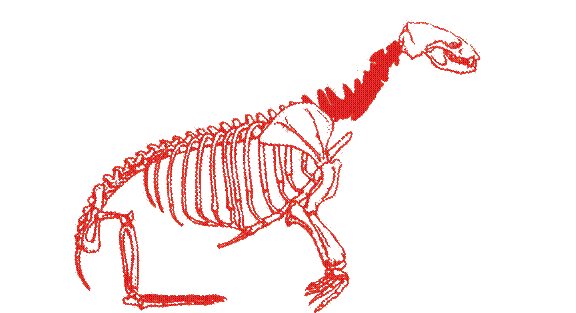
In the early days you could have the island to yourself and it was possible to walk the entire length of the beach at Seal Bay amongst the mostly sleepy and sometimes inquisitive and playful younger sea lions. Those were the days. Visits to the beach to view the seals is now limited to a brief tour with the ranger every 30 minutes through out the day and you can only walk to within 20 feet of the entire colony of seals. Today people visit the island by the hoards, see all of its major sights in a day and return to the mainland without enduring much of the tricky gravel roads. The adventure has given way to en masse tourism and environmental soundness. Leaving a cloud of red dust and finding uninhabited places has always been a favorite holiday and escape for me. Driving on KI without experience on gravel roads can be tricky and many foreign visitors have ended up rolling their vehicle whilst negotiating a simple bend while for me it is a joy. So for me visiting Kangaroo Island was truly a get away and an adventure. Again this last time did not disappoint me despite the many more tourists, the sealed roads and the limited entry to this National Park. As well as a sealed road, a ranger's office had been built and a board walk constructed across the delicate sandy environment to manage the tens of thousands of visitors each year to the bay. On this most recent visit to Seal Bay with my sons, for the very first time I entered the ranger's office and was immediately taken aback by the full size skeleton of the Australian Sea Lion. It was of a large animal perched on both its front and hind limbs (fore and hind flippers) with its head forward. A mature female I thought. I was particularly taken by the size and shape of its spine. The neck vertebrae were larger than the lumbar vertebrae, opposite to humans and most mammals. Indeed an upside down spine. The neck vertebrae had massive transverse processes (a transverse process is wing shaped bony protuberance from the body of the vertebrae for the attachment and action of muscles). Two extraordinary large scapulae were slung either side at the base of this huge neck while a tiny barely recognizable pelvis supported the hind legs. Why have a spinal column decreasing in size from the head to the tail and why such large scapulae and such a small pelvis? My first impression was to do with the weight bearing through the front or fore flippers for locomotion on land and during stance when the big male bulls confront each other in competition over the females. The seals can stand upright with the head directed vertically and straight up from the fore flippers. Two large bulls will engage in a confrontation in this posture with the weight bearing through the fore flippers and hence my first impression of the large neck and scapulae being related to locomotion on land and fighting.
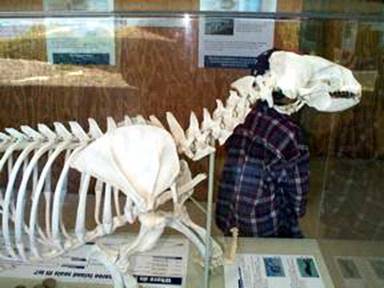 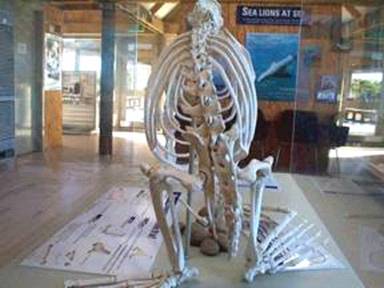 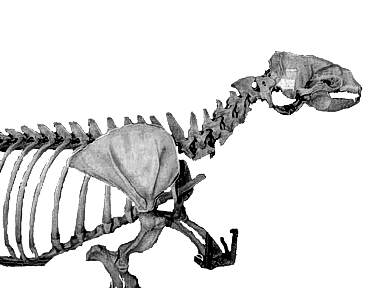 My first impression was not quite right, indeed in fact, it was wrong. It turns out that there are two types of seals; the true seal or earless seals (Family Phocidae) and the eared seal (Family Otariidae). True seals have no external ears hence the name "earless" or true seals. These animals use the hind flippers for locomotion in the sea and the fore flippers act as rudders. The hind flippers alternately come towards each other and then expand away. The inward stroke is the recovery phase and the outward stroke is the propulsion stroke. Locomotion is assisted by a side to side motion of the lower end of the body and hence large lumbar vertebrae.
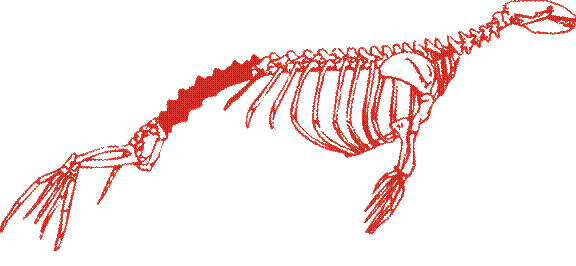 Eared seals (including the Australian Sea Lion) have a small external ear and swim using the large fore flippers as the major force for propulsion while the hind flippers are used for steering. The propulsive motion of the fore flippers is like that of oars, the fore flippers pull inward toward the body and hence the seal can "fly" along like penguins. The major locomotor action emanating from the fore flippers and front half of the body determines the large cervical and thoracic vertebrae and huge scapulae. Hence my first impression for the reason for this upside down spine was wrong. My attention in the observation of this amazing anatomy was with the seal's ability to move on land and not in the sea. The eared seal can actually "walk" on land as we know from the circus and aquarium seal. The seal advances each fore flipper alternately while shifting its body weight over the weight bearing limb by swinging the head and neck side to side (humans also shift weight but in a more evolved way without the high energy cost of throwing the head and neck side to side- see "Human Locomotion-the Fish and Crocodile story" chapter?). The hind flippers advances in the same manner and the animal walks on land using all four flippers and the body remains elevated from the ground. At higher speeds or at a gallop both the fore flippers advance together followed by the hind flippers. The true seal has less ability on land. This animal is rather clumsy and it locomotes something like a caterpillar with varying use of the fore flippers. The Grey Seal can grip onto rocks with the fore flippers and crawl forward. The Harbor Seal uses the fore flippers to weight bear and drag the rear half forward.
So what?So what. What has this mammalian functional anatomy tale to do with human movement and musculoskeletal medicine? This upside down spine is a small but not so insignificant tale that provides an inspiring beginning to the discussion of what is Feldenkrais and what it brings to the understanding of human movement and rehabilitation. The relationship between structure and function across the phyologeny of these animals provides a useful analogy to introduce the differences and comparisons between medicine and Feldenkrais. Structure affects function and function affects structure. These two seal species evolved differently from possibly the same ancestor to related but very different structure and function to locomotion at sea and on land. The discussion of Feldenkrais and medicine begins with the relationship between strcture and fucntion. Medicine is primarily strutcure based while Feldenkrais is concerned with function and yet both are interrelated parts of the same thing. To expedite this discussion I have coined the term "first, second and third orders of movement" to classify movement into a simple clear mechanism for describing what is Feldenkrais and how it operates and compares to musculoskeletal medicine. Each order of movement is described separately and then compared before coming back to the humble Sea Lion.
Movement of the First OrderNine in the morning on my first day of physical therapy training I stood before a table upon which lay what was clearly a human body wrapped in strips of white cloth soaked in that invading odor of chloroform. There were at least fifty of these tables on the second floor of the medical school. With gloves snapped into placed I followed directions to remove the cloth and make an incision along the anterior chest wall of the cadaver before me on the table. It is not quite like walking on the moon but still a memorable first nascent event in a new and long career. A memorable and indeed a very grateful privileged and honored moment at the time and more so now for such an opportunity is no longer permitted. Systematically we dissected the cadaver limb by limb, joint by joint, muscle by muscle and nerve by nerve. Each cadaver remained on the table all of that year for our learning. At the end of the year the cadavers were placed in a simple casket and cremated.
This is how I learnt anatomy. Weekly lectures, text books and exams followed this same structural regional approach, in fact, this system for classifying human anatomy and function is called regional anatomy. Anatomy is described by regions, neck, knee, back etc. Each bone, muscle, nerve and each individual function are defined separately. For example the knee has three bones of a particular shape and biomechanical relations. There is the femur, tibia and patella. Two major muscle groups act on the knee, the quadriceps muscles on the front of the thigh straightens or extend the knee and the hamstrings posteriorly produce bending or flexion. There is some rotation of the knee controlled by the hamstrings and the popliteus muscle. Femoral and sciatic nerves activate these muscles to produce movement of knee bending and straightening. Though somewhat oversimplified this is basically how anatomy is taught and learnt in training to be a doctor or allied health professional. Anatomy and function are defined by region on a real live dead model. Regional anatomy is the anatomy and function of a dead person. This is movement of the first order.
history of anatomyEarly medicine was driven by anatomical dissection. Cadavers, animals and even live wounded subjects were systematically sectioned to classify the human structure and its pathologies and injuries. Modern medical practice in rehabilitation owes a lot to the fore fathers of anatomy- Galen and Vesalius. Vesalius systematically dissected the human body into its regional parts. This regional classification of human anatomy is logical and convenient. Dissecting out and naming each muscle, each bone and each nerve according to its anatomy and basic individual function is the history and basis of modern musculoskeletal medicine. It is a logical starting place and an essential knowledge for all medical professionals. It is the mainstay of modern medicine and quite rightly. All of medicine is based on regional anatomy as the basis of its methodology to find a solution, a diagnosis, an interpretation of what is the cause back pain, or knee pain or leg pain and to determine the correct treatment. It is totally logical and valid and vital aspect of studying human movement as related to musculoskeletal syndromes and dysfunctions. A second and eternal fact in this regional approach to musculoskeletal medicine is the endless list of people presenting to doctors rooms with regional pain. "My knee hurts, my back aches or I twisted my ankle". The regional presentation of pain logically leads to a regional evaluation, diagnosis and treatment. Thirdly, medicine has been very successful in identifying regional pathology causing the pain and dysfunction of presenting musculoskeletal disorders. Ligament rupture, disc bulge, bone fracture are all identifiable pathologies by medical investigations. Knee, back and ankle pain and all musculoskeletal pain syndromes are well investigated and dealt with this methodology. Fourthly, medicine based on this first order works. It is very successful.
modus operandiThe primary modus operandi of this structural approach in the rehabilitation clinic to strengthen and stretch muscles and to mobilize joints to increase range of motion. A less primary but equally ancient and favored technique in the rehabilitation clinic is the application of heat, cold, cream and hands to sooth pain. As we shall see later in this book the modus operandi of the relieving of changing pain for pain sake is an error. For doctors in their medical rooms the modus operandi is to refer patients to PT or specialist doctors or to inject medication into the local region or to supply medication for a general affect to reduce pain or inflammation or to relax muscles. Surgeons can repair, reconstruct, cut out or replace damaged structures. This is musculoskeletal medicine today. Yet by its very brilliance, necessity, history, logic and convenience this methodology shadows another order of movement - the coordination of all these regional sections into a functional whole.
Movement of the Second OrderThe second order of movement pertains to how the human structure functions; including how the brain controls senses and learns movement. Simply put, how does 10,000 billion neurons control over 200 bones and 600 muscles to produce human movement? The human brain has a sense of movement known as the kinaesthetic or the sixth sense (more later). There are receptors, proprio-ceptors, in the periphery (that is outside of the brain) that provide the brain with information about specific aspects of movement; movement (position, orientation and velocity) contact, force, timing and linkage of segments (more later). The production and processing of information from these receptors is called proprioception. The brain's interpretation of proprioceptive information contributes to what is called the "body scheme". The body scheme is a kind of working model of movement also described as a "blue print for movement" (Berthoz 2000) or the "laws of movement" (Bermudez et al 1998) (more later). The brain has a perception of local and global arrangement of all body segments constantly whether you are thinking about it or not. The human ability to sense proprioception is defined as the sixth or kinaesthetic sense.
child learnsA child learns in its first year of life to roll over, sit up, crawl, stand and walk. This process involves movement of the second order. Here the child learns how to coordinate all body segments to perform different developmentally sequential tasks. The child's brain is not concerned with muscles and certainly not muscle strength and length. The child may discover something about range of motion by finding out that the foot can reach the mouth. But this success at reaching the mouth with the toes and reaching the toes with the mouth will be remembered just as that and not as a description of hip range of motion or what muscles were contracting. Range of motion is always contextual to a functional ability.
dance and golfA dance choreographer observing a dancer perform will not be concerned with the first order of movement of muscle strength and length. The choreographer is concerned with form and style and technique- all features of the second order of movement. The concern for any individual muscle length and strength will be for the ability to obtain and hold a shape or form or complete a movement. Affecting movement of the first order in this example is contextual to a function (second order) and not regional. The golf coach has the unenviable task of observing his student's arrangement of the entire skeleton including aspects like the width of stance, the weight shift across the feet, the action of the hips, the gaze of the eyes and the timing and forces developed along the kinematic chain of action from the feet to the hands. The golf coach knows only too well from his years of practice how much these things have to with hitting the ball long and accurately.
The dance choreographer and the golf coach attain their professional status only after years of practice in the chosen performance. Years of dancing leads to a learning on and from oneself about movement. So too the golf coach can only determine a golfer's needs in his swing from years of his own experience. Feldenkrais practitioners too learn by this methodology. Training begins with experiencing and exploring all of the movements of the first year of human life. Motions of the infant like rolling, crawling, shifting from all fours to sitting and back are examined experientially on your own body. This methodology leads to an increased self awareness of the second order of movement but not necessarily the first. This learning increases proprioceptive acuity and enhances the person's sense of movement or the sixth sense. The big unknown here in medicine and the big premise in Feldenkrais and now increasingly understood in neuroscience is that it is possible to influence and enhance the sense and control of movement to improve function. All basic human movement functions like walking, reaching, stepping, twisting can be affected by learning a new coordination of movement. This is the number one premise of the Feldenkrais Method. It is not so surprising nor demanding immediate skepticism because already we know that people can become dancers and golfers and thereby greatly redefine their movement abilities. The second major premise from the Feldenkrais Method is that improving function or coordination or affecting the second order of movement changes pain (See chapter Fixing pain or increasing proprioceptive acuity or improving function). The second of movement pertains to the understanding and use of the brain's ability to sense and learn movement for greater control, awareness and coordination of movement.
back to the upside down storyBack to the Australian Sea Lion. Viewing the seal skeleton for the first time in that plastic box in the ranger's office on Kangaroo Island, all of this preceding description flashed through my mind. Here was a beautiful example from another world that could inspire a discussion of a functional versus a structural view of anatomy. Here was a story to inspire and lead a discussion of the difference between the first and second order movement and then the respective different approaches to affecting human movement. For me it was not possible to look at this animal and compare the two skeletons and think first order of movement. I immediately thought function and second order of movement. Another factor to consider is the evolution of this species. The Australian Sea Lion and families of the true and eared seals evolved from a life on land as a terrestrial mammal that then returned to the sea. Consider what forces may have lead to the two different skeletons evolving from possibly the same animal or similar animals.
structure versus functionThe first order of movement provides a structural view of movement. What muscles are involved? How is the range of motion possible at a joint? What limits motions of a joint? The second order is functional. Movement is viewed locally and globally simultaneously. The questions of how is the brain coordinating the relationships between segments (thigh, lower leg, trunk, arm etc). The first orders deals with the connection of segments eg the knee is the joint between the thigh and lower leg. Joint range of motion and limitation are the parameters for assessment. In the second order of movement the behaviour and control of each segment are the primary parameters for assessment (more later).
Whilst musculoskeletal medicine uses the first order of movement as its primary methodology the Feldenkrais Method utilizes the second order of movement. The differences are not absolute nor exclusive. There is some overlap but generally this differentiation is accurate. It is not that musculoskeletal medicine rejects the second order of movement or that assessment, diagnosis and treatment via the second order of movement is alternative or complimentary or not medicine, rather, it is just that medicine has yet to fully discover and realise the potency of this methodology in rehabilitation, function and performance. It is not a question of comparison for determining which is the better methodology, it is "not either or but both and more". The upside down story simply and clearly defines these two methodologies for observing and studying movement. The actual practice of utilizing the second order of movement to affect musculoskeletal pain requires further description and is the subject of the rest of this book.
Movement of the Third OrderThe simplest explanation is that all movement is an expression of the person. The simplest example was given by Darwin in his book "The Expression of Emotions in Man and Animals":
 The two dogs by their actions and posturing quite clearly display emotion. It is easy to pick some on who is happy, or is sad or is depressed. We all do this knowingly and unknowingly. Maybe you can try to make a science out of it but this is yet to be realized. Every practitioner in every field and every person has a sense of the third order of movement i.e. a little sense of who the person is, something of who they are and something about how they present with their presenting problem. After all, we are all people whether a patient or doctor. And while it is possible to have an entire career as a doctor doing medicine in the regional structural mode with no understanding of the second of movement it is really impossible to avoid the person in the patient forever. The main feature of this third level of movement are the words or language or expression that exists between the lines of the vocal and motor actions in the interaction between two people. If I were in the presence of the angry dog above I may feel that anger and even hear the words angry emanating from that animal. Likewise the cowering dog may express words in the mind of the observer of submission. The chronic pose and attitude of anger will lead to the dog above becoming fixed in this posture and attitude. This state when overly practiced becomes the norm and appears at times when even in fact the animal may not want to be angry. The chronic submitting action or behavior may become the dominant behavior for that animal. These are all possible mechanisms occurring in the third order of movement -the relationship of movement to our emotions and psyche. Now if either of these animals became chronically stiff in these attitudes and postures and presented for treatment for back pain there would be issues of pain, movement and attitude to deal with. Perhaps the learning of new movement habits and abilities is enough to give the animal or person all the clues they need to resolve their stuckness and move on.
body-mindFeldenkrais contends that ultimately the body-mind connection does not exist, they are the same thing, there is no difference:
"My contention is that the unity of mind and body is an objective reality, that they are not entities related to each other in one fashion or another, but an inseparable whole while functioning. To put it more clearly I contend that a brain without motor functions could not think or at least that the continuity of mental functions is assured by corresponding motor functions".
We have to be careful and totally respectful in this third order (see Chapter "The body and consciousness").
take home messageOne take home message for now is that the humble but not so small Australian Sea Lion offers an entry into the discussion of the relationship between structure and function. It offers a new set of eyes for viewing human movement- one that seeks to determine the relationships between structure and function of human movement in a particular environment. Recently I visited the Museum of Fine Arts in Boston to view the Gainsborough exhibition. Art is a beautiful thing to me; it brings enormous pleasure and great wonder and amazement at the work, skill and imagination of the artist. However, on this occasion I was a little disappointed. Not being a big fan of this period and style, I nevertheless entered the exhibition with an open mind. I found myself to rather quickly move through each room and pass quickly by each painting. Every face in the entire collection looked gaunt and miserable. Talk about the third order of movement. Was Gainsborough a miserable soul to paint his subjects so sadly or were these people miserable? Showing my lack of art history and indeed of history itself a curator at the museum informed me that the people of the day had rotten yellow and missing teeth and so artists never depicted smiling faces. The only teeth you would see from this era were the teeth of beggars and clowns included in some of the paintings. My mind jumped immediately to the definition and discussion of orders of movement. What dentistry has done this past century for the teeth, eventually medicine can do for the human body. From pulling teeth to later discovering good dentine management by cleaning, filling, capping, crowning and regular visits to the dentist, dentistry has transformed itself and the life our teeth. So if Gainsborough were alive today he may himself have a perfect smile that could be comfortably displayed on canvas or in public. Medicine and PT can not yet define their profession as broadly effective in prevention as can the dental profession. One of the greatest advances of musculoskeletal medicine in the next 25 years will be the adoption and practice of the second order of movement in theory, diagnosis and treatment of musculoskeletal pain. This will be one major factor leading to greater prevention and management of musculoskeletal disorders. In the same way that dentistry has been able to minimize rotten teeth and extend the life of our dentures to an entire life span so too will it be possible to lessen the number of rotten hips, knees and bones. The adoption and integration second order of movement into medical practice will greater contribute to the reduction, the extent and frequency and suffering from arthritis in hips and knees and it will also be a powerful tool in minimizing osteoporosis.
As I perceive it Feldenkrais can currently claim to have the ability to provide the practice of prevention and long term management of human structure and function. Regarding the thirds order of movement, in the same way that people looked miserable with their rotten teeth so too will we look especially happy with our agile mobile bodies. Hence the oft quoted Moshe Feldenkrais motto:
"Life is movement, without movement there is no life".
SummaryMovement of the first order is a structural textbook approach to studying movement. The body is divided into its apparent regions by the relations between every two bones. It is derived or rather contrived from a systematic classification of the structures and movement of a cadaver, ie a dead person. The second order of movement deals with the question of movement in the living human, how the brain controls, senses and learns movement in both the regional and the global context. The second order of movement is a functional approach to studying human movement. Whilst the potency of a methodlogy based on the second order of movement is yet to be realised in medicine or sports performance Feldenkrais is the art and practice of such a methodology. Feldenkrais is not alternative or complimentary medicine- it is movement education or movement learning. Medicine and sports performance methodologies would do well to be fully acquainted and integrative with this methodology. The third order of movement concerns the "body-mind connection". Classically, the mind is left to the psychologists and psychotherapists without reference to body functions. The body is left to the doctor. The third order of movement is that world of the link between the body and the self. All medical practice includes a little body-mind awareness and use. It is human to do so. The difficult part is determining a definition and working description of such a process.
|
||
 |